I only teach what I'm still walking.
This is where I work out boundaries, ADHD, and inner child (and grown-up) parts, out loud. From the middle of it, not the far side. If you have even the slightest desire to engage with yourself and your inner world, and you want more awareness, you're in the right place.
Know it. Name it. Do it.
Know what your moral compass values. Name what is non-negotiable when something crosses that value. Then make a plan for how you'll protect that value and make clear a limit was crossed. Without action, a boundary is only an intention.
Find the value underneath
What am I actually protecting? A limit with nothing behind it caves the first time someone pushes.
Say it in one sentence
If it takes a paragraph and an apology, it's still a request. Naming it out loud is the part I'm practicing. Not the deciding. The clarifying.
Choose my own action
The action is mine, not theirs. I stand in my moral truth whether or not they agree with me.
The boundary I'm practicing isn't with another person.
It's with myself. Right now I'm working on noticing the moment I start questioning myself, or my own reality, when someone is upset with me. I name it to myself: the “I feel crazy” feeling is starting in this situation. That's my signal a limit is being crossed, in how I'm turning on myself.
My action is to name what's happening and give myself permission to detach in a healthy way from the situation, because of the way I'm feeling, and not take ownership of it. I refuse to believe the narrative that is being spoken in this situation.
Then I ask myself: “Would I be upset with this person for the things they're upset with me about? Would I treat them the way they're treating me?” If the answer is no, I name that I fully believe this crosses my moral value. I leave the narrative with the other person.
What I name to myself:
“The ‘I feel crazy’ feeling is starting in this situation.”
I share more of this on Instagram →Pick the one that's loudest today.
Say the limit out loud
The formula, and what to do when the boundary doesn't hold the first time.
Read more → ADHDFor the women who got missed
ADHD in girls and women, from inside one brain, not a textbook.
On Instagram for now → Inner childWhose voice is that?
Tracing a grown-up reaction back to the kid who first learned it.
On Instagram for now → BooksThe My Voice series
Picture books that give kids words for a feeling before it gets big.
On Instagram for now →Defining Your Boundaries
A live session on the three steps. We find the value, write the limit in one sentence, and pick an action that holds. You leave with a filled-in worksheet, not just notes.
Write your first boundary tonight.
One printable page: the formula, one worked example, and blank lines for yours. I'll also send a short note when something new goes up. No sales sequence.
Boundaries, said out loud.
Everything here runs on one formula. It's short on purpose. A boundary I can't remember is a boundary I won't keep.
Write one right now.
Start with the value. The limit gets much easier to word once you know what it's protecting.
The deciding isn't the hard part.
- Know it. If I can't say what I value, I will not be able to stay connected to myself and my standards.
- Name it. One sentence. When I find myself wondering if what I'm naming is “fair” to the other person, I stop and start over again.
- Do it. My action, my follow-through. I can't make them agree. I can decide what I'll do.
- When it collapses. It will sometimes. I notice how long it held, and I set it again.
Defining Your Boundaries
Over the past five years of unmasking and finding my true self, I had to dig into what boundaries actually are. I think in systems, so I broke it down into three simple steps: Know it. Name it. Do it. This course walks you through them, so you can identify your core moral values and know how to recognize and respond when they’re being crossed.
For women. Co-ed trainings available by request.
Coming soon.
One page. Your first boundary.
The formula, a worked example, and blank lines for yours.
Hi, I'm Marcy.
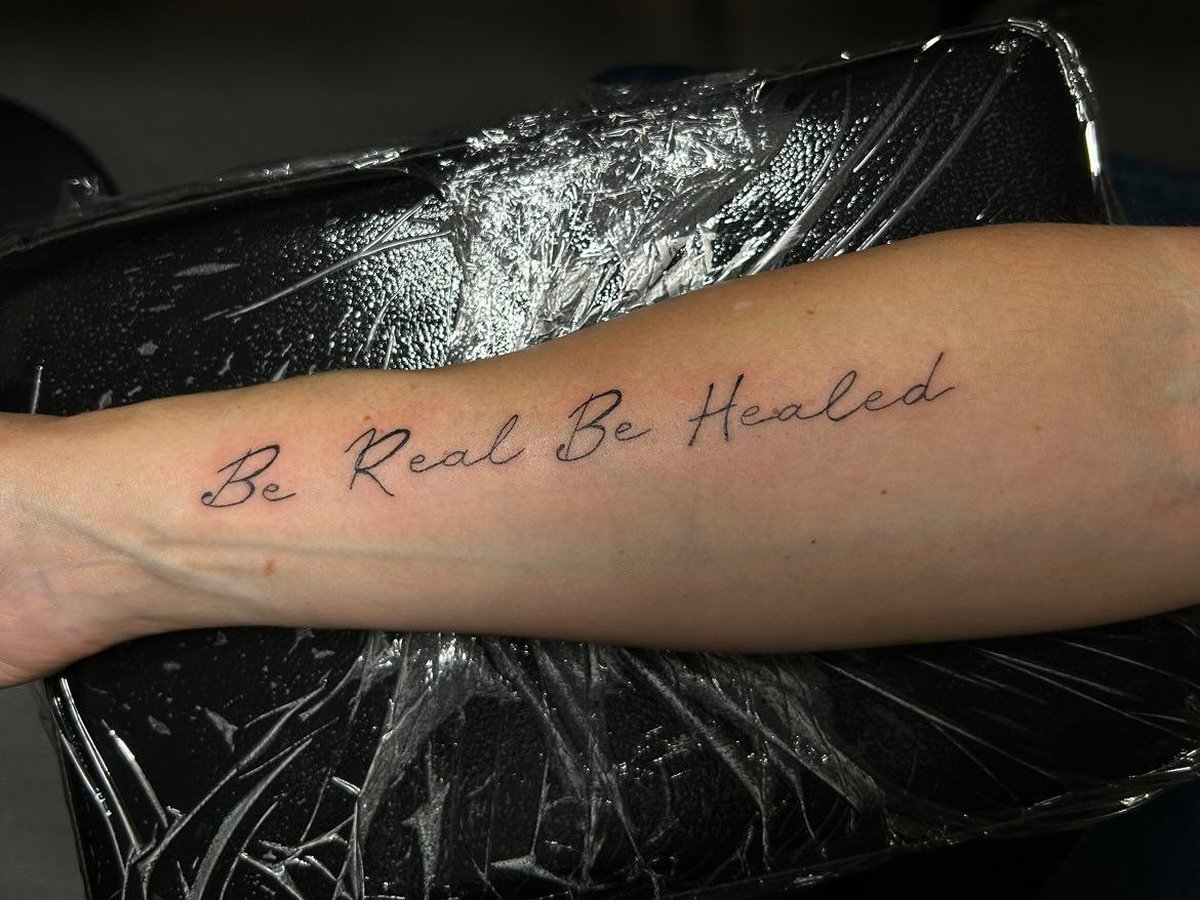
Be Real Be Healed is tattooed on my arm. It isn't a slogan. It's something I have to keep choosing.
After a lifetime of masking, my mask started to come down five years ago, when I began trauma and inner child work with a psychiatrist and a trauma counselor.
In that season I saw how being fully real (authentic, transparent, and vulnerable) lets you be known by others. They become the safe people who witness it, and that is what brings healing.
I only teach what I'm walking myself.The one rule
You're out of the worst of it. You're not solid yet.
You're self-aware and tired of wellness content that sounds like it's already arrived. Maybe you're raising a kid whose brain works differently, or figuring out your own. You don't need a pep talk. You need someone honest who's still in it with you.
That's what I'm trying to be. Some weeks it goes better than others, and I'll tell you which.
Four things I'm working on.
Know it. Name it. Do it.
The formula I teach and keep practicing.
Read more → ADHDGirls and women
From lived experience, not a clinic.
On Instagram for now → Inner childInner child parts (and grown-up parts)
Where the reactions started.
On Instagram for now → BooksMy Voice
The picture book series, starting with My Shy Voice.
On Instagram for now →